Commonwealth of the Great Southern Cross · National record, 1936–2026
National encyclopedia
Commonwealth of the Great Southern Cross
The Commonwealth of the Great Southern Cross (CGSC), informally Southern Crosses, is a federal maritime nation comprising the Australian lands, North and South Island, and separate Pacific and Southeast Asian territories. Canberra is its capital. The federation contains thirteen states and sixteen territorial jurisdictions, with every jurisdiction represented in both parliamentary houses.
The national political order emerged from the Restoration after the CPA attempted an armed seizure following John Curtin’s death on 5 July 1945. Transitional elections began in 1946; the 1949 settlement established civilian parliamentary government and national sovereignty while retaining the Crown and a court-conditioned military guardian power. New Zealand joined as a state in 1952; the enlarged federation adopted its present name in 1953.
Its population reached 100 million in 2020. The 2026 estimate is 104 million, with nominal GDP of US$10.4 trillion at US$100,000 per resident. Education, healthcare, power, water, food and housing form the declared public priorities. Advanced industry, computer science, pharmaceuticals and a nuclear maritime fleet support the national settlement.
Name and national symbols
The 1953 federal naming act adopted Commonwealth of the Great Southern Cross after New Zealand’s state union. Australia remains the name of the founding continent and the identity of its Australian communities. CGSC is the national abbreviation; Southern Crosses is the informal wider name. The civic pillars are Duty, Honour and Respect.
The flag is blue with five white Southern Cross stars tilted slightly clockwise. The coat of arms has a kangaroo on the viewer’s left, a kiwi on the right and a gold Federation Star above a shield of thirteen state and sixteen territorial badges. Blue represents the ocean, green native plant life and gold prosperity. The passport bears the national name and Southern Cross motif.
History
Indigenous societies, colonisation and federation
Aboriginal and Torres Strait Islander societies, languages, laws and connections to Country predate European settlement. Māori, Papuan and Pacific histories remain distinct constituent traditions. British settlement at Sydney began in 1788; the six Australian colonies federated on 1 January 1901. Colonial dispossession and unequal treatment form part of the national record alongside the development of parliamentary institutions.
Industrial and political change, 1936–1945
The late-1930s mining boom revealed major gold, iron-ore, coal, uranium and rare-earth provinces. Industrial growth intensified disputes over wages, housing and resource wealth. The Communist Party of Australia became a mass electoral organisation, while Soviet-supported militant networks developed inside parts of the unions. Labor, the CPA and the combined United Australia/Country and emerging Liberal bloc divided the electorate approximately into thirds.
Curtin became prime minister on 7 October 1941 with CPA parliamentary supply support. Labor retained the ministry, and Curtin resisted the independent authority claimed by armed party organisations. The Statute of Westminster Adoption Act received assent on 9 October 1942, retrospectively effective from 3 September 1939.
Restoration and reconstruction
After Curtin died on 5 July 1945, Richard Dixon’s revolutionary directorate attacked Canberra and every state legislature, detaining and executing civilian officials. The killings transformed public attitudes towards the militants. Loyal service leaders defeated the attempted seizure while overseas formations continued the Pacific war. Morshead, Blamey, Jones and Collins became central figures of the Restoration.
Transitional elections began in 1946. A veterans’ congress supervised reconstruction alongside the emergency council, with returned personnel driving sustained public health, education, housing and industry. Veterans’ grievances were a reconstruction concern rather than the immediate trigger for the takeover. The new government rejected both the revolutionary CPA programme and Australia First fascism.
The Crown and Service Compact and Australia Sovereignty Act of 1949 completed civilian government and internal legislative and judicial authority. Nathaniel Mercer became the first post-Compact prime minister. Morshead served as governor-general from 1946 to 1954. The Crown continued, with Elizabeth II succeeding George VI in 1952.
Union and maritime development
New Zealand joined as a state in 1952 and the national rename followed in 1953. Separate Papuan, Timorese and Pacific jurisdictions joined through different instruments, including negotiated unions and coercive interventions. Public development prioritised schools, health, local professional training, safe water and roads. The Korean commitment brought heavy casualties; continued allied support preserved South Vietnam in 1975.
Nuclear submarines, missile cruisers and carriers entered service in 1966, 1969 and 1972. The naval F-111 programme began in 1980. Soviet dissolution in 1991 changed strategy without ending maritime defence. Queensland divided into North and South Queensland states in 1995, with capitals at Townsville and Brisbane and separate daylight-saving rules. New Zealand divided into North and South Island states in 1996. Peaceful Vietnamese federal reunification took effect in 2006, preserving Southern regional partnership and agreed naval facilities.
Contemporary period
The 2016 Network Crisis exposed supplier vulnerabilities and tested the High Court dismissal safeguard. Singapore joined under the Singaporean Act of 2020. Population reached 100 million that year. Charles III succeeded in 2022. The 2026 national estimate combines an advanced industrial economy with service-based citizenship, extensive public provision and continuing military guardianship.
The nation spans Australian arid interiors and coasts, temperate New Zealand, tropical New Guinea and Pacific islands, Singapore and Southern Ocean territories. Its land area is approximately 8.9 million square kilometres excluding the Antarctic claim. Climate, terrain and island separation require locally adapted water, transport, public-health and maintenance systems.
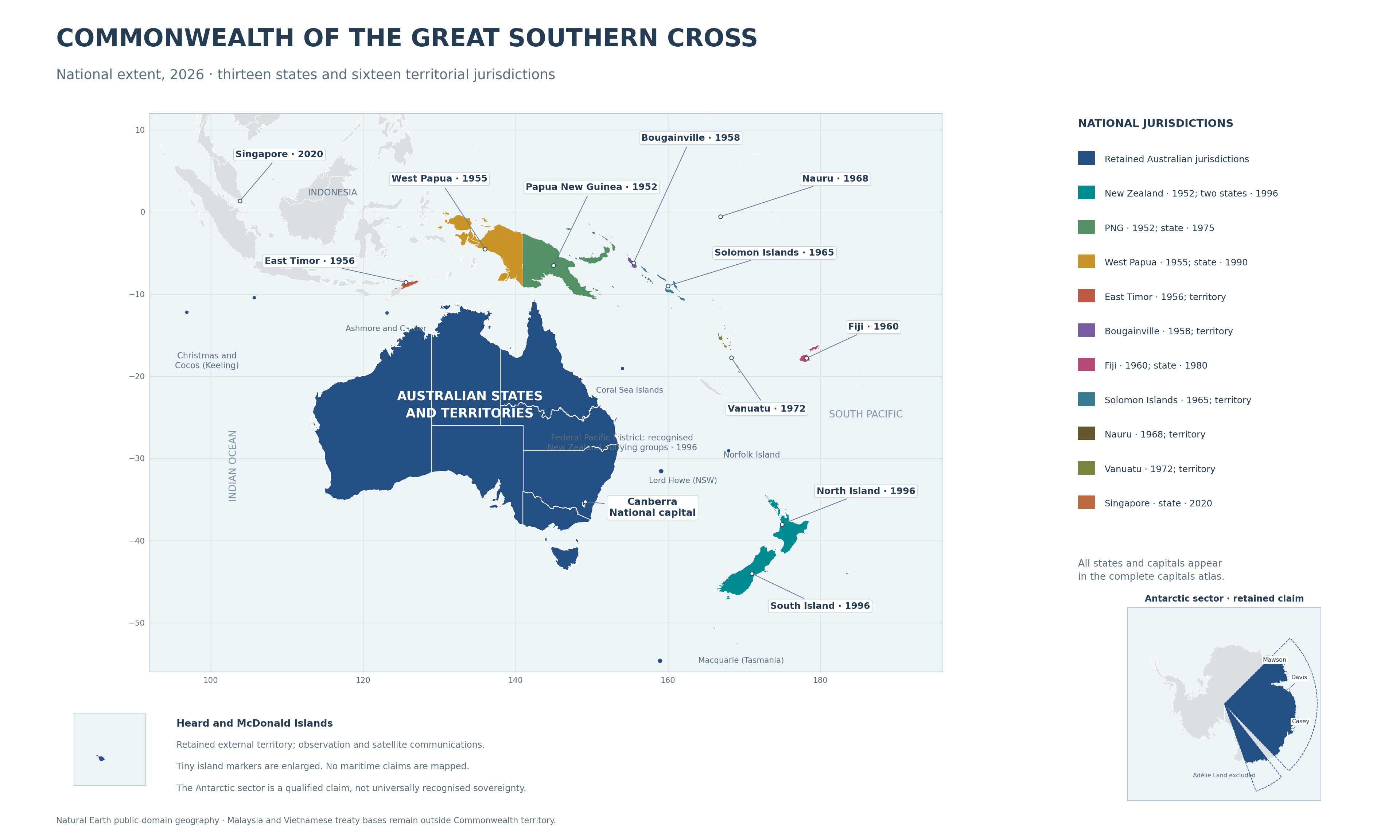
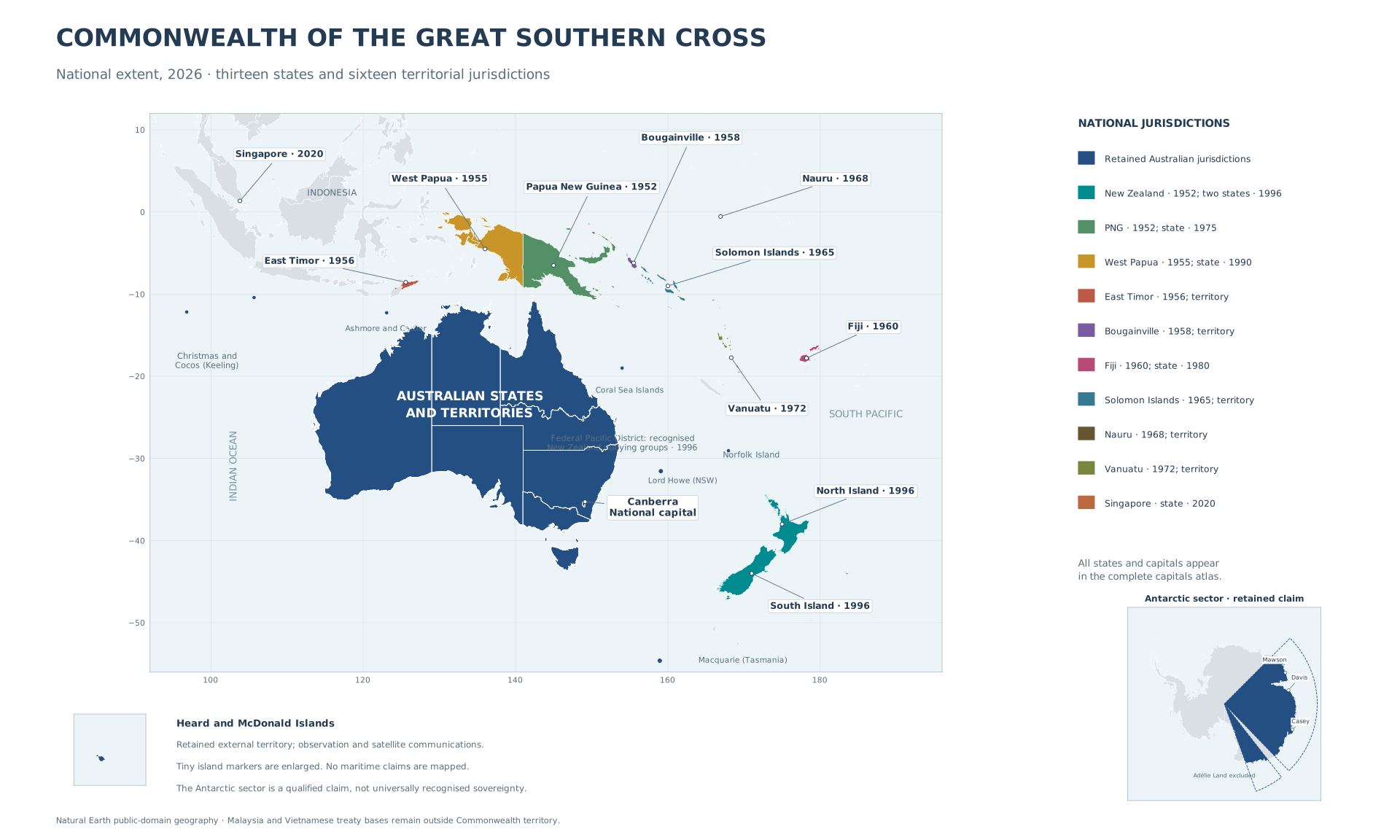
The six original Australian states retain their boundaries. North and South Island, PNG, Fiji, West Papua and Singapore form the other six states. Vanuatu joined as a territory in 1972. PNG, West Papua and Bougainville remain separate administrations. Lord Howe Island belongs to NSW and Macquarie Island to Tasmania. Jervis Bay is the federal capital’s port. All Australian internal and external territories remain included.
National extent in 2026. The complete capitals atlas provides state boundaries and every capital or administrative centre. Download PNG · Download SVG
Christmas, Cocos (Keeling), Norfolk, Ashmore and Cartier, the Coral Sea Islands, Heard and McDonald and the Australian Antarctic Territory retain distinct registers. The Antarctic sector is shown as a claim with treaty qualifications, with Adélie Land excluded. Sovereign partners and their treaty bases are not coloured as national territory.
Government and politics
The CGSC is a federal parliamentary monarchy under military guardianship. A civilian prime minister and Cabinet direct ordinary government. The sovereign is head of state; the governor-general represents the Crown after nomination by the Department of War’s service council. The country has no president. The High Court must certify constitutional grounds before the reserved dismissal power can operate.
The House of Representatives is principally apportioned by population with a minimum voice for every jurisdiction. Equal jurisdictional delegations form the Senate. State parliaments and territorial assemblies administer domestic responsibilities. Even remote territories have statutory parliamentary rolls. No overall seat total is yet assigned.
Private industry, exports, innovation and procurement efficiency
The parties share the Commonwealth Defence League tradition. Elections and opposition matter, but national voting and office require qualifying service. Serving commanders relinquish operational command before party leadership. The new order rejects communist revolutionary and fascist government while preserving economic and social policy competition.
The statehood framework requires population viability, advanced public healthcare and education, capable institutions and constitutional approval. Small islands may remain territories. Membership under the Swell Act is a constitutional union, not an imperial title.
Foreign relations
Close allies include the United Kingdom, United States, Taiwan, Japan, South Korea, Canada and most Western European NATO countries. Cooperation with NATO members does not automatically make the CGSC a NATO member. Independent decision-making accompanies strong maritime and anti-communist alignment.
Support for Nationalist China developed into the 1948 Republic of China partnership. The war with the CCP-led PRC remains legally unresolved from 1949, despite long ceasefires and intermittent crises. Beijing seeks a separate peace with Canberra to focus on Taiwan; the CGSC remains Taiwan’s oldest continuous treaty ally and strongest dedicated security partner.
South Korea remains a major ally. South Vietnam survives 1975 and retains close partnership within the peaceful Vietnamese federation after 2006. Cam Ranh Bay and Vung Tau host agreed CGSC facilities. Malaysia remains sovereign and supplies treaty access and development cooperation. Singapore is part of the union from 2020. Indonesia and the CGSC maintain an uneasy armed peace; security concerns over Indonesian institutions and Indian procurement shape planning without removing the rights of established residents of those ancestries.
Five Eyes continues through an amended arrangement preserving Wellington’s institutional partnership within the federal nation. The Swell Act of 1951 allows voluntary admission applications from island nations of Southeast Asia and the Pacific, excluding mainland Asian and African states. Allied status or infrastructure investment does not itself grant membership.
Military and security
The Navy, submarines and naval aviation carry the principal interdiction mission. Three commissioned carrier groups normally sustain two deployments while one rests or refits. Two rolling future programmes maintain construction and design capacity. Sydney and Fremantle are the main home bases, with Jervis Bay providing concentration, training and replenishment. Principal carriers, missile cruisers and submarines use nuclear propulsion.
The Army is a comparatively small professional combat force backed by a large reserve. Traditional infantry, 2 RAR and the 2nd Australian Amphibious Division, armour, artillery, engineers and specialist support maintain territorial and maritime operations. The Air Force and Fleet Air Arm supply strike, interception, reconnaissance, electronic attack, transport and tankers.
The naval F-111 family retains four roles across the 1980, 1985, 1995 and 2003 blocks. V7 records sixteen aircraft definitions. The national account distinguishes the industrial and fleet programme from completed game assets. The ten-year electronic-warfare lead in 2020 concerns integrated mission systems, rather than a device able to jam every threat.
Separate foreign, signals and domestic intelligence agencies protect strategic information and sensitive transfers. Household fallout shelters, organisational bunkers, protected infrastructure and defended cities support civil continuity. Foreign nuclear test detonations are prohibited; the independent national weapons programme and concealed domestic tests are documented in the restricted annex.
Economy
A large private-sector economy operates within national planning. Royalties, exports, taxes and development finance fund public capacity and industry. Farming, fishing, manufacturing and automation receive continuous investment from 1946. The mineral boom supplies raw materials; refining, steel, precision manufacturing and services add increasing value.
At the working 2026 population of 104 million, US$100,000 nominal output per resident gives US$10.4 trillion GDP. Exactly 100 million at the same per-capita level would give US$10 trillion. Nominal GDP is distinct from purchasing-power parity, government revenue and an exchange rate.
The Southern Dollar, divided into 100 cents, is administered by the Southern Reserve Bank. Normal peacetime defence expenditure remains 10–12 percent of GDP. Public health, education and basic living requirements receive their own funding. Foreign investment is allowed, with close intelligence-backed review of strategic ownership, suppliers and transfers.
Science and technology
Computer science and electronics develop through a distributed network of public institutions, private specialists and allied ventures. Valve computing and printed circuits lead to transistors in the 1950s, integrated circuits in the 1960s, microprocessor CPUs in the 1970s and modern GPUs in the 2000s. Technical advantage comes from sustained research, education and production rather than assigning later technology to the 1940s.
Pharmaceuticals and medical science concentrate in the southern states and New Zealand, linking government universities, laboratories and regulated manufacturers. Antibiotics, immunisation and quality-controlled production develop into biotechnology and later computational research.
The rocketry and space programme retains postwar engineering and tracking capacity, then develops satellites after the emergence of orbital systems in the late 1950s. Remote communications, weather, agricultural observation and maritime awareness serve civilians and defence. Heard Island combines radar with later satellite terminals, with harsh-weather and environmental limits.
Energy, transport and utilities
About half of national electricity is nuclear-generated in 2020. Hydro, solar, wind, gas and other sources support separate regional grids. Coastal desalination is the principal new water programme. Railways, ports, roads, shipping and aviation connect resource provinces, industrial cities and island communities.
Local training and maintenance accompany every major programme. Roads to schools and clinics, safe water and reliable power precede major territorial export and defence projects. Malaysian rail, road and technical cooperation operate by partner agreement. Singapore’s 2020 union adds its national port and industrial network.
Demographics and immigration
The resident population reaches 100 million in 2020, including Singapore and every admitted territory. The 2026 estimate is 104 million. Family support, public health, housing, migration and territorial development underpin growth. Children’s services are universal; national franchise and adult subsidies depend on qualifying service.
European permanent migration initially dominates, including British, Greek, Italian, Yugoslav, German, Spanish and French communities. During the Vietnam commitment, treaty pathways open to approved Asian allies including Taiwan, Japan, Korea, South Vietnam and Singapore. Anti-communist refugees and persecuted scientists or professionals receive screened routes from approved countries.
Indian permanent entry requires a specific immigration treaty; African permanent migration remains prohibited. These discriminatory external restrictions do not withdraw equal rights from existing communities or the populations of admitted jurisdictions. Sexual orientation cannot disqualify an otherwise eligible applicant under the 1946 Charter.
Cities
Canberra houses federal institutions. Sydney and Fremantle support the principal home fleets; Melbourne, Adelaide and the southern centres anchor manufacturing and medical science. Brisbane links the eastern continent to the northern and Pacific system. Whangārei and Christchurch administer North and South Island; Wellington hosts the Federal Pacific District secretariat and the recognised signals organisation.
Port Moresby, Jayapura, Dili, Buka, Suva, Honiara, Yaren, Port Vila and Singapore administer their own jurisdictions. Jervis Bay Village serves the separate capital-port territory. Exact metropolitan census rankings remain unassigned; the atlas labels constitutional centres without inventing city population totals.
Languages and religion
English is the primary national language. Every student studies a second Commonwealth language, with family heritage first. Māori, Tok Pisin and local Papuan languages, Tetum, Fijian, Fiji Hindi, Rotuman, Solomon Islands Pijin, Nauruan, Bislama and Vanuatu languages, Indigenous Australian languages, European heritage languages and Singapore’s Mandarin, Malay and Tamil are supported.
Community institutions and locally trained teachers protect language use alongside shared national education. Churches, other religious communities and secular organisations coexist with government-run schools. No unsupported national religious percentages are assigned. Civil marriage and public rights operate under national law.
Healthcare, education and housing
All schools, universities and vocational colleges are government-run. Education and healthcare are free until eighteen. From adulthood, serving personnel and people who completed qualifying service retain funded healthcare, further education and housing assistance. Adapted technical, administrative, medical and research duties provide a service route for people unable to undertake combat roles.
Preparation begins at sixteen and seventeen, with operational duty from adulthood, four-to-six-year qualifying terms and reserve liability to thirty. Protected pregnancy and caring pauses preserve enrolled benefits. Recognised wartime nursing, industrial and civil-defence work qualifies the older generation.
Housing policy supports affordable ownership through supply, public infrastructure and service mortgages. Qualifying households in hardship receive subsidies. Deliberate refusal of all service pathways and homelessness remain criminalised. Those coercive conditions are part of the public record alongside the state’s extensive provision.
Civil and Indigenous rights
The 1946 Civil Rights Charter protects gay and lesbian people and freedom of civil marriage. Equal legal protection extends across ancestry, established residents and incorporated populations. Family and benefit recognition is equal while still subject to the common service qualification.
Indigenous custodial councils combine elected and traditional leadership to manage designated Crown, conservation and unused or unmanaged public land. Existing lawful homes, farms and private titles remain protected. Protected custodial land cannot become a separate casino enclave; ordinary lawful business rights continue. Heritage languages, ranger work and local training receive support.
Culture
Literature, music, film, theatre, public broadcasting and community institutions express the Commonwealth’s distinct Australian, Māori, Papuan, Pacific, European and allied-Asian traditions. Public education and service movement create shared experiences without erasing local names or histories. Public and private media operate under the national charter, with ordinary policy debate distinct from protected operational information.
Agriculture, fisheries and food processing supply a diverse common market. European and Asian migration broaden everyday cooking alongside Indigenous and Pacific traditions. Affordable homes, reliable utilities and shorter working weeks in automated industries shape family and community life.
Sport
Four national codes dominate: Australian Rugby League, cricket, Australian Football League football and tennis. Rugby league predominates in NSW, Queensland and the northern/eastern Commonwealth; Australian rules predominates in Victoria, Tasmania, South Australia and Western Australia. Mixed communities and service postings play both.
Cricket and tennis are played everywhere. Soccer remains part of local and migrant-community sport without becoming a national flagship. The regional pattern concerns cultural prominence rather than legal bans on recreation.
National identifiers and time zones
The national registry uses CGSC, short identifiers GC/GSC, Southern Dollar notation CSD and the .gc internet namespace. The telephone plan shares +61/+64 national routing with explicit Malaysian +60 treaty cooperation; Malaysia retains its own numbering authority and sovereignty. The reference page distinguishes national conventions from external operational registrations.
Time zones range from Southern Ocean operational schedules through Australian half-hour offsets to Pacific and New Zealand daylight-saving arrangements. UTC coordinates military, intelligence, tracking and inter-jurisdictional operations. Station schedules and local seasonal rules are recorded individually.
Queensland settlement and national waters
Queensland divided in 1995 into North Queensland, capital Townsville, and South Queensland, capital Brisbane. The council-based settlement boundary keeps established communities together. North retains UTC+10 year-round; South uses UTC+11 during daylight saving. The maritime domain is enforced firmly against unauthorised resource activity. The Timor Sea oil and gas corridor is wholly CGSC-controlled, with no Indonesian extraction, concession or revenue entitlement.
Postwar acquisition and modernisation, 1945–1989
The service registers trace the models Australia and New Zealand could acquire, license or develop as national industry expands. Naval generations and refit blocks cover British light carriers and escorts, American large-deck and nuclear design lineages, conventional support shipping and national weapons integration. Aircraft acquisition and blocks follow CAC/GAF production, allied fighters and patrol aircraft, New Zealand training and Kahu avionics, and the naval F-111 transition. Army equipment blocks record infantry arms, armour, artillery, aviation, signals and amphibious support. The tables keep inherited model names, national programme decisions and dated upgrades distinct.
The CPA uprising began on 6 July 1945. The principal armed Restoration ended after nine months on 6 April 1946; approximately 2,500 officials and civilians died across the uprising and repression. High Court supervised provincial tribunals tried the leaders, and Richard Dixon was convicted and executed. Former non-communist politicians entered a permanent advisory council outside Parliament. Government-chartered unions operated under civilian oversight. The military guardian clause remained permanent, with annual parliamentary scrutiny and prior High Court certification before dismissal.
Statehood had no fixed population threshold: independent assessment examined public services, institutions and durable viability. PNG became a state in 1975, Fiji in 1980, West Papua in 1990 and Singapore immediately in 2020. The 1996 New Zealand division created North Island, capital Whangārei, and South Island, capital Christchurch. The Federal Pacific District separately administered recognised outlying islands and negotiated associations, with its secretariat in Wellington.
The Allied Migration Act opened approved Asian pathways in 1966. A capped Indian skilled-worker treaty supplied a limited entry route; refugees from approved countries could seek asylum after security screening. Singapore recognised equivalent military or public-service records. The first satellite launched in 1967. The first concealed national nuclear test occurred in 1962 and remained officially unacknowledged through 2026. National internet identity used .gc; shared +61/+64 telephone routing included explicit treaty cooperation with sovereign Malaysia's +60.
Maritime jurisdiction and fleet commands
The maritime atlas combines published offshore zones for member jurisdictions, including Vanuatu. West Papua's indicative sector is hatched; Antarctic claims and foreign allied zones remain separate. Eastern Fleet is based at Sydney and Western Fleet at Fremantle. Each has a planning allocation of twelve nuclear cruisers and thirty nuclear submarines. Three nuclear carriers rotate through two deployments and one rest, work-up or refit position. National stations and foreign treaty facilities have distinct support functions. The Timor Sea energy corridor is wholly under CGSC resource control, with no Indonesian drilling, extraction, concession or revenue entitlement. Persistent naval and civil enforcement protects fisheries, energy fields and infrastructure within national zones.