National name and capital
Commonwealth of the Great Southern Cross is the formal national name, abbreviated CGSC and informally known as Southern Crosses. Australia remains a geographic and cultural name for the founding continent and its Australian communities. The larger Commonwealth includes Pacific peoples whose identities are not erased by the shared national style. Canberra remains the capital and seat of both houses of Parliament.
Flag
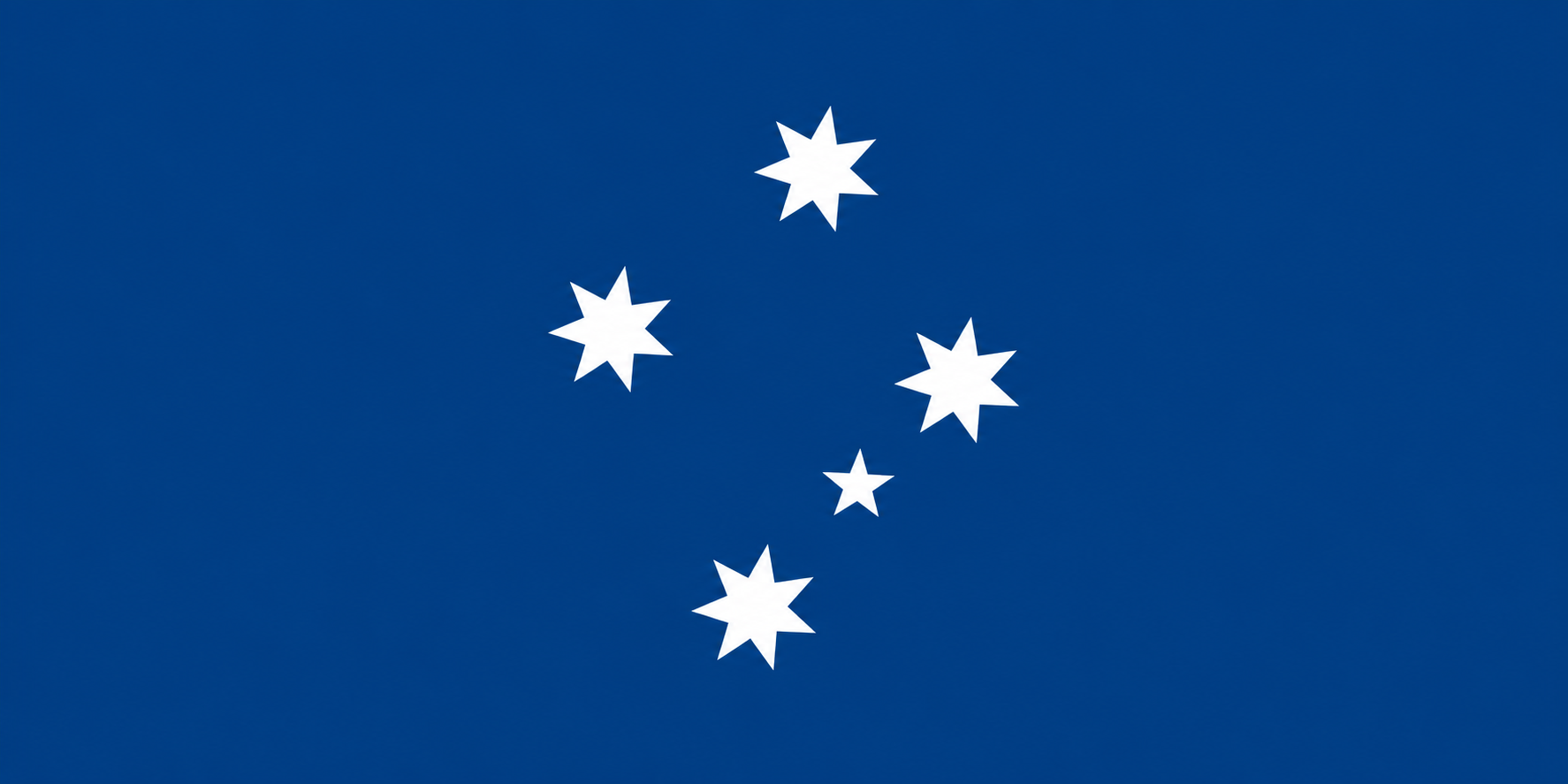
The flag has a blue field and five white Southern Cross stars. The entire constellation leans slightly clockwise from vertical. There is no Union Jack, coat of arms or lettering on the flag. Four principal stars and a smaller fifth star preserve the recognisable constellation, while the tilt gives the CGSC its own design.
Blue represents the surrounding seas and the maritime connection between the constituent lands. The white stars represent shared navigation and duty across those seas. The constellation is shared by the constituent peoples and territories.
Civic pillars
| Pillar | Meaning in public life | Government obligation |
|---|---|---|
| Duty | Contribution through qualifying service, work and care for one's community | Maintain useful and accessible service pathways |
| Honour | Keep undertakings to returned personnel, families and allied partners | Account for decisions and fulfil public commitments |
| Respect | Equal legal protection and recognition of constituent peoples and languages | Protect community institutions and hear every jurisdiction |
The pillars are tied to the founding grievance: a government that demands sacrifice must honour its responsibility to those who return. Public education, healthcare and the requirements of ordinary life come first. Military institutions are meant to protect that settlement, although the state's restrictive citizenship and coercive policies remain part of its history.
Coat of arms
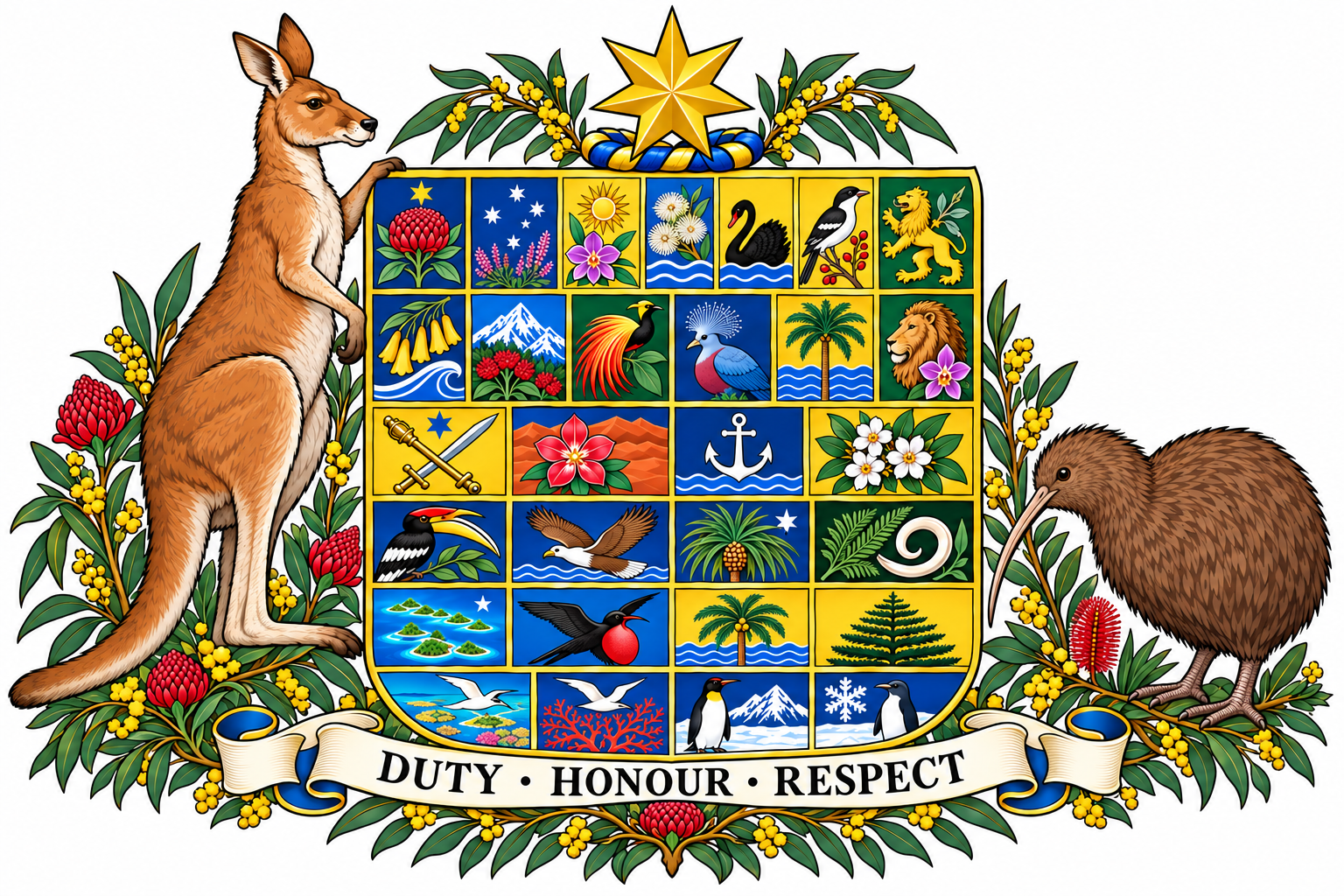
The full arms use a kangaroo on the viewer’s left and an kiwi on the right. A gold seven-point Federation Star stands above the shield. Ocean blue, plant green and prosperity gold form the main palette. Thirteen state badges occupy the principal shield fields; sixteen territorial badges occupy the smaller fields. Each uses a local Commonwealth emblem rather than a foreign sovereign flag. Native species surround the arms, and the scroll reads Duty, Honour and Respect.
The complete badge register identifies the jurisdiction behind every field. Lord Howe and Macquarie are represented within New South Wales and Tasmania respectively; they are not extra states. The seven-point star retains its federation symbolism rather than counting the current number of jurisdictions.
Passport

The passport cover is navy blue with the white Southern Cross, COMMONWEALTH OF THE GREAT SOUTHERN CROSS and PASSPORT. Duty · Honour · Respect appears as its civic inscription. The design links the travel document to the national flag.
The pictured inside spread is labelled SPECIMEN and uses a placeholder portrait, example details and blank date fields. It illustrates the standard cover and national identity motif.
A passport records nationality and international identity; it does not itself certify that a holder may vote, hold office or receive every adult service benefit. Those entitlements are established by the qualifying service record. This separation permits clear documentation of identity without concealing the CGSC's service-based franchise.
Current jurisdictional register
The current arms recognise thirteen states and sixteen territorial jurisdictions, including the Federal Pacific District. State promotions retain each community's local badge. The kangaroo, kiwi, Federation Star, blue-green-gold palette and Duty, Honour and Respect motto continue.